After the Machine Shop
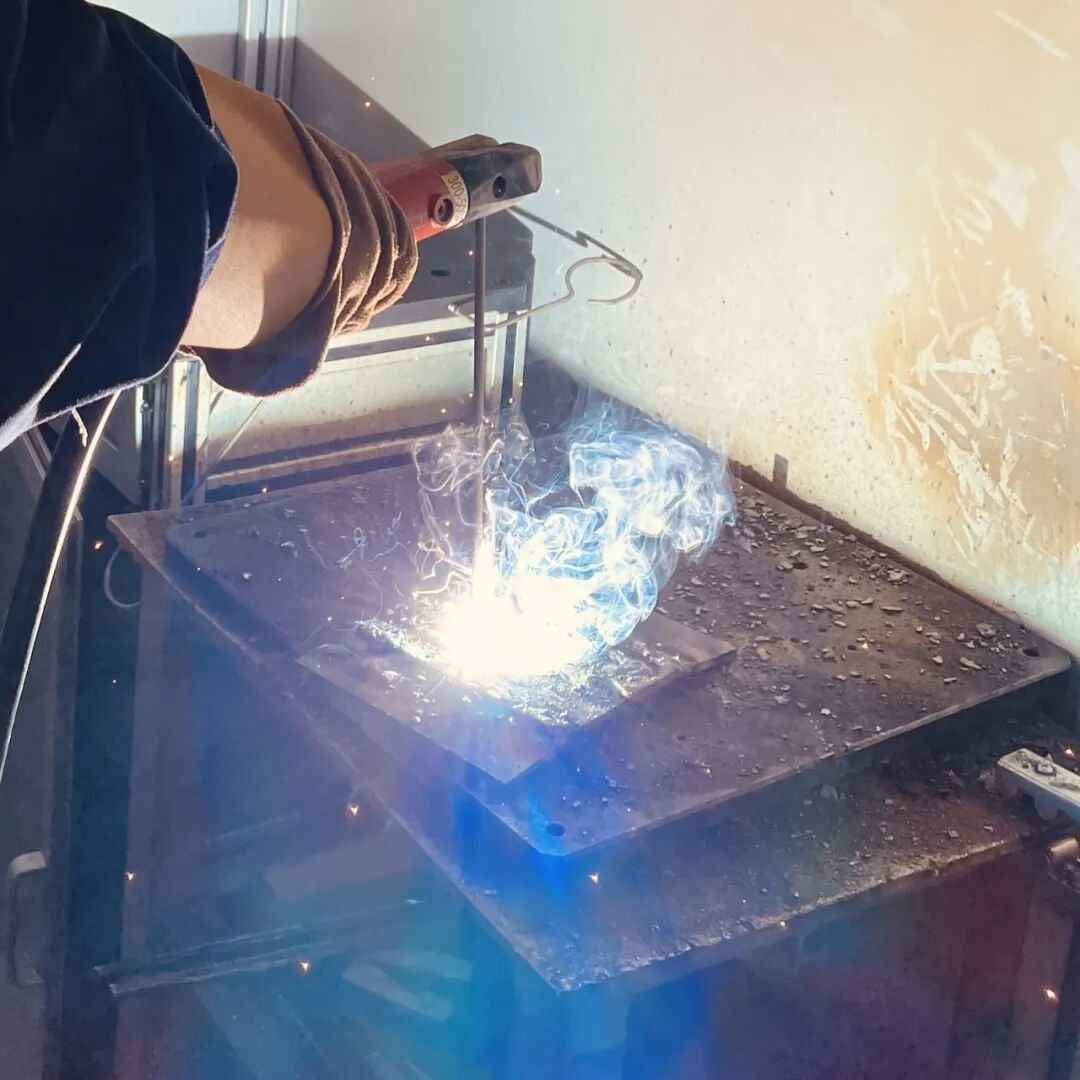 The blue-white smoke of stick electrode arc welding
On the first day of the metalworking practicum, when I walked into that tidy workshop with dozens of lathes scattered across the floor, I had no idea I would learn this much in a little over ten days.
The journey took me through turning, bench work, welding, casting, and smart manufacturing. By the end, I felt I had gained more than a few hands-on shop skills, more than a look at some very precise and very expensive machines, more than the satisfaction of finishing a part with my own hands. What I really came away with was a leap in how I understand things.
I realized long ago that I am astonishingly ignorant about the modern world.
I think back to a chemistry class in high school. The teacher was walking us through the electrode reactions of a lithium battery. She reached one knotty part of the equation, paused for a few seconds, and then said slowly:
"The details here are still being debated. There is no agreed-upon theory yet."
That sentence set off a storm in my head. I had assumed a battery was a simple, well-understood little component, used everywhere, and it had never crossed my mind that it could be so complicated. From that day on, I wanted to get to the bottom of how the modern world actually holds together, to keep digging at the technology and theory hiding behind everything we treat as ordinary.
After all, as a modern student, not being able to answer "how is the stuff I use every day actually made?" would be a little embarrassing.
Now and then I daydream about traveling back to ancient times, using my modern knowledge to bootstrap an industrial and technological civilization, becoming the time-traveler who saves the world and finally lives out my grand ambitions.
But is that actually doable?
Forget chips and robotic arms and the high-end stuff. Even making one decent hammer turns out to be hard. The head has to be iron or stainless steel, so you need a properly smelted block of metal. For that, you need to know how to mine good ore, and how to create temperatures high enough to melt it.
Oh, and at this point you have no electric furnace and no excavator. You do not even have a halfway decent hammer, because making a better hammer is the very thing you were trying to do.
Trace the chain of modern industrial production and your thinking falls into a strange little loop, a "modern industry cycle."
If you ask: how is a machine made?
Someone will tell you: people operate machines to make it.
Following the thread of how things get built, armed with nothing but common sense, your mind drifts upstream from the endpoint of modern industry back toward the past, and keeps running into these self-referential dead ends that look impossible to untangle.
I can pay with a QR code, mess around on a smartphone, type on a keyboard.
But if you ask "how does this actually work?"
I can give you many, many layers of answer, and yet you can always keep asking until you hit a question I cannot answer. Maybe "how is the transistor inside an electronic device made?" Maybe "what process produces the screen on a phone?" Or "how does memory actually work?"
When I noticed that questions like these existed, I found that my wish to understand the modern world had run straight into a wall that looked impossible to climb.
How do you machine materials that are extremely hard? Welding melts metal with high heat to join it together, so how do you deal with the air getting in the way? How do you heat metal that hot in the first place? My tools, the electrical box, the welding torch, the sandpaper, how was any of it made? How was the first lathe built? Where did the first gear come from? And on and on.
Take the ordinary things we never think twice about, keep asking why with no end in sight, and the questions branch out like a tree, more and more of them, until you finally get stuck on a knot you cannot work loose. Worse, the questions industry sets off are both many and wide. They bounce back and forth between theory and technique, and they pull in history, the history of science, the history of technology, even futurology. None of the teachers or books I had met before could resolve all of this tangle.
I had never once glimpsed the whole of this enormous industrial world, built up layer by layer out of craft and technology.
So why am I especially grateful for this metalworking course?
Because I finally, just barely, managed to see that "whole."
At the very start, I was a little puzzled by how the course was laid out. Turning, bench work, welding, and casting all looked like relatively basic and old techniques, so why were they grouped together with smart manufacturing, which only shows up in Industry 3.0 and 4.0?
Once the classes actually got going, I understood the logic. Turning runs from the first ordinary lathes China imported, on to CNC lathes and milling machines, with the range of motion and the level of automation climbing the whole way. Welding runs from the earliest stick electrode arc welding to the increasingly sophisticated setups of CO2 shielded welding, argon arc welding, and welding robots, where better tools let us pull off more and more complex work. Casting and heat treatment answer the question of how the very first blank gets made. Bench work shows up across the whole stretch from rough blank to precision part.
The path from traditional trades to smart manufacturing is nothing like some sudden leap. It is a real, intricately interwoven succession of technical iterations. From forging a blade in early firelight to the precision and efficiency of a lights-out factory, those two far-apart ends are joined by an unbroken, web-like chain of advances.
I am sure there are countless details I still do not understand. But those two distant ends have finally been connected and lit up inside the map of what I know, and from that I understand the modern world a little better. There is a settled, satisfied feeling that comes with that kind of knowledge.
If someone now pointed at a model of a rocket engine and asked me, "Hey, do you have any idea how something this complicated gets made?"
I might answer: "It is a long story, but you could start by piling up some sand......"
写在金工实习之后
焊条电弧焊的蓝白色烟气
第一天开始金工实习的时候,走进那错落放置着数十台车床的整洁车间,我没有预料到我会在这短短的十余天中学到这么多。
在这遍历了车工、钳工、焊工、铸造、智能制造的旅程中,我觉得我自己不仅仅是学会了基础工业的一些操作技巧,不仅仅是见识了高精尖的精密仪器设备,不仅仅是体会了一把自己动手完成产品的过程,更是收获了认知的飞跃性提升。
我很早就意识到,自己对现代世界有着惊人的无知。
记得在高中的一节化学课上,当时老师在给我们讲述锂电池的电极反应式。在一个复杂的反应式上,她的讲述停顿了几秒钟,然后慢慢地说:
「这一处的细节,学界尚在讨论,还没有一个公认的正确理论。」
这一句话在我心中掀起了惊涛骇浪——我原以为电池是一个原理简单、广泛应用的基础零部件,而从未想过它竟是如此复杂。自那起,我就一直想要究明现代社会何以成立的原因,刨根问底地去追问常态背后的技术和理论。
毕竟,作为一个现代学生,要是连「我每天都在使用的产品是怎么生产出来的?」都回答不上来,那未免也太寒碜了。
偶尔会幻想自己穿越到古代去,凭借现代知识建立工业科技文明,打造「穿越者救世」的功业,实现自己的宏图大志。
但这真的是一件可行的事情吗?
且不论芯片机械臂这些高端的产品,即使是打造一个称手的锤子也已十分困难——锤头的材质是铁或不锈钢,所以你需要有冶炼好的金属块,为此,你要知道如何开采高质量的原料矿石,如何创造超高温环境让金属熔融。
哦对,这个时候你没有电炉也没有挖掘机,甚至说,你连一个好一点的锤子都没有,因为你的目的就是造个好一点的锤子。
顺着现代工业的生产链条思考,我们的思维会陷入一个诡异的「现代工业循环」。
如果你问:机器怎么造的?
有人会回答你说:人操作机器造出来的。
追溯造物的脉络,仅凭常识,思绪从现代工业的终点向过去逆流而上,常会遇到这些看似无解的自我指涉。
我会用二维码付钱,会玩智能手机,会敲键盘打字。
但如果你问:「这是怎么实现的?」
我可以给你回答很多很多层,但你终究可以追问到一个我无法回答的问题,或许如「电子设备里那个晶体管是怎么造的?」,或许如「手机上面那块屏幕是什么工艺造出来的?」,或者如「内存的工作原理是什么?」。
当我意识到存在这样的问题的时候,我发现自己理解现代世界的愿望撞上了看似无法逾越的墙壁。
硬度极高的物质是如何加工处理的?电焊使用高温融化金属接到一起,那空气的影响如何解决?怎么把金属加热到这么高的温度?我的工具、电箱、焊枪、砂纸,这些东西都是怎么制造出来的?第一个车床怎么造的?第一个齿轮哪里来的?等等等等。
生活中诸多习以为常的平凡事,要是不断追问下去个没完,问题就像树状结构的枝叉一样越来越多,最后往往卡在一个无法想通的死结上。更糟的是,由工业制造所引发的疑问多而且广,在理论与技术之间来回横跳,还涉及到历史、科学史、技术史、未来学的问题,我此前遇到的老师和书本都无法全部解决这些林林总总的问题。
我从未窥见过这个庞大的、由工艺和技术堆积起来的工业世界的全貌。
为什么我特别感激「金工实习」这门课程呢?
因为,我终于勉强看清了这一份「全貌」。
其实在,最开始的时候,我对课程安排稍稍有些困惑——车工、钳工、焊工、铸造看起来都是相对基础和古老的技术,为什么会和智能制造这个工业3.0和4.0才有的新事物放在一起?
但真正上课之后,我明白了其中的道理。车工的技术从中国进口的第一批普通车床,到后面的数控车床、铣床,自由度和自动化程度不断上升。焊工从最初始的焊条电弧焊,到工装越发高级复杂的二氧化碳保护焊、氩弧焊、焊接机器人,越来越好的工具让我们可以实现越来越复杂的工艺。铸造和热处理解决了「最开始的毛胚如何制造」的问题。钳工则是出现在从毛胚到精密加工的整个过程中。
从传统技术工种到智能制造的过程远非某种「突然飞跃」,而是实实在在地存在错综复杂彼此交织的技术迭代,从最早的炉火中锻刀,到无人工厂的精密高效,这遥远的两端被网状的科技迭代连续不间断地连接在了一起。
虽然许许多多的细节之处我肯定还不甚清楚,但这遥远的两端在我的知识体系中终于被连通点亮,由此我对现代世界多了一份理解,得到了这份知识带来的安定感和满足感。
如果现在有人指着一个航天发动机模型,问我:「诶,你知不知道这么复杂的东西是怎么造出来的?」
我或许可以这样回答:「说来话长,但你可以先从堆沙子开始.......」