Cover the Canvas (a translation)
On a whim, I sat down to translate a blog post called "Cover the Canvas." It was written by Steven Pressfield, the well-known screenwriter and novelist. His prose is short and forceful, the kind that gets your blood going. I have read this piece many times, and every time it hands me a little more courage and a little more drive.
A note: the original is so good that no translation can carry its full spirit. I would point you to the link at the bottom, which goes straight to the original post. 🔗
Is the first draft the hardest one?
Is it really any different from a third draft, or a twelfth?
Does a first draft come with its own peculiar difficulties, the kind we have to go after in a way that is all its own?
The answer to all three is the same: yes, yes, and yes.
First drafts are killers
A first draft is unlike every draft that follows it, and harder than all of them, because in a first draft we are filling the blank page. And we know what that means. Resistance.
Here is my mantra for first drafts: cover the canvas.
What that means is simple. Get something done, start to finish, no matter how rough. A first draft does not have to be great. It does not have to be pretty. It can have holes in it. It can leave shorthand and scribbles that only you can read, handwriting so messy nobody else stands a chance. Your passion is the whole game in a first draft. Just get it done. Cover the canvas.
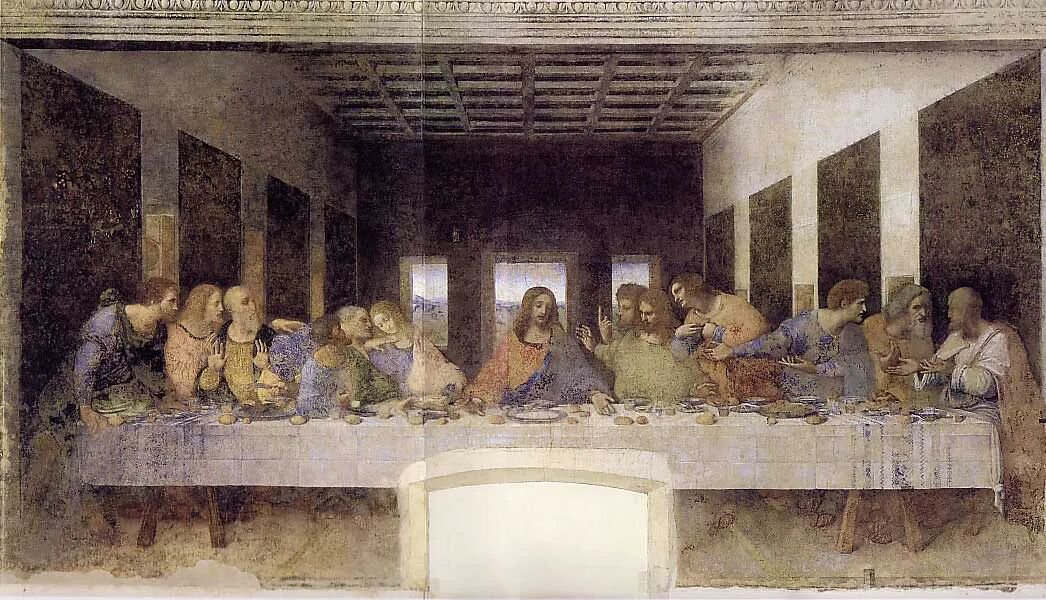 The Last Supper
Resistance and first drafts
Why does covering the canvas matter so much? Because in the first draft, the Resistance you face is at full strength. The blank page, day after day after day. Resistance has tens of thousands of chances to hand us a reason to quit. The project is too hard, too painful. A million other people are doing the same thing and doing it better. We are too old, or else too young. The bottom line is always the same: we are not worthy!
If we dawdle over the first draft, even good news can wreck us. A raise, a promotion, a new baby, a winning lottery ticket. And just like that, our great work gets set aside, and then it is gone.
Cover the canvas. If the new piece is The Last Supper, paint in the apostles, paint in Jesus, set the table. Do not fuss over the details. It does not matter if Matthew's hair is wrong, or if Peter's left hand has four fingers. We will fix that later. Get the picture finished. Cover the canvas.
Some clever so-and-so once said, "There is no such thing as writing, only rewriting." He was wrong. The first draft is writing, the pure thing, from nothing to something, ink on a blank page. But he was also right. Because after the first draft, all that is left is rewriting.
In the first draft, our one job is to beat Resistance. Quality comes second; it can wait. First you have to get something down, however lousy, something that roughly resembles a book, a doctoral dissertation, a new business proposal. Once we have that, we are over the hump.
Advancing on Baghdad
General James Mattis commanded the 1st Marine Division in Operation Iraqi Freedom. His mission was to take Baghdad and drive Saddam Hussein from power. His plan of attack was exactly the same as our plan for writing a first draft.
(It was also, by the way, the plan General Schwarzkopf used in Desert Storm, the one Erwin Rommel used in the blitzkrieg conquest of France, and the one Caesar and Alexander used in every battle they ever fought.)
Mattis made his "commander's intent" plain. Here is what he told his Marines: speed is everything, keep moving no matter what; if we hit resistance, go around it; keep pushing north and do not stop.
What Mattis and his Marines were really trying to do was break the enemy's morale and drain his will to fight. By moving his force so fast, Mattis meant to sow panic, to make the enemy believe nothing on earth could stop their advance.
It worked. The Iraqi soldiers defending Al Kut and An Nasiriyah wore civilian clothes under their uniforms, so that the moment a chance came they could throw off the uniform, melt into the crowd, and slip away with their lives.
When our "commander's intent" is cover the canvas, we have a strong, clear order that sets all our priorities for us.
March on the finish line. Do not stop.
Go around the trouble spots. Keep advancing.
Why does covering the canvas work?
The genius of this idea is twofold. First, we find that once we have gone around a few of the hard spots, those hard spots tend to dissolve on their own. Second, once we reach our objective, however shakily we got there, the enemy gives up. He never expected us suddenly at his doorstep. He can only wave the white flag.
Our enemy, as artists, is Resistance. If we make the mistake of chasing perfectionism in the first draft, if we wrack our brains over getting the grammar right and take a whole week to finish Chapter One, then by the time we reach Chapter Four we have already hit the wall. Resistance will beat us.
But if we can stay nimble and keep moving, slapping paint on the canvas and words on the page until we have cobbled together something whole, however imperfect, then we are like Mattis's Marines arriving at the gates of Baghdad.
True, with the first draft finished there is still plenty of work left. But one way or another, we have reached high ground. We have something we can use and improve.
Cover the canvas.
(The end.)
A few words from the translator
I first came across this piece in happy xiao's newsletter "Coke," linked below. I recommend subscribing by email. (No, nobody is paying me to say that.)
The lesson in "Cover the Canvas" is a plain one.
Before exhaustion and procrastination get their hooks in you, get the thing mostly done, and leave the fine details for later.
Whenever you find yourself stuck and hesitating, say it to yourself like a charm:
Cover the Canvas!
Cover the canvas! Keep advancing!
I am Luna Mare. Thank you for reading.
You are welcome to reach me any way you like.
My email is lunar_mare_official@outlook.com.
Write to me anytime. I answer every letter. 🙂
译介丨填满画布 Cover the Canvas
心血来潮,来翻译一篇博客文章「Cover the Canvas」。这篇文章的作者是 Steven Pressfield,一位著名的编剧和小说家。他的文字简短而有力,让人热血沸腾。这篇文章我读了很多遍,每一次都能得到一些信心和鼓舞。
注:原作者文章写得极好,翻译难以传达其中神髓,推荐直接点击文末「阅读原文」,那是指向原博客文章的链接。🔗
初稿是最难的吗?
初稿和第三稿或第十二稿,是不是有根本性上的不同?
初稿是不是有特别的困难之处,以至于我们必须找到一个独一无二的方法,才能完成它?
这三个问题的答案是:是的!是的!是的!
初稿是杀手
初稿不同于所有后续的草稿,也比后续的草稿更难。这是因为做初稿时我们在填补空白页。而我们知道填补空白意味着什么:「阻力」。
我对初稿的口头禅是:填满画布(Cover the Canvas)。
这意味着,你要从零到一完成一些事情,无论多么不完美。初稿不一定要伟大,不一定要漂亮。它可以有漏洞:可以留着一些只有自己看得懂的简写和记号,可以把字写得潦草到认不清楚。你的激情是初稿的一切。完成它。填满画布。
《最后的晚餐》
「阻力」和初稿
为什么填满画布如此重要?因为在初稿中,你受到的「阻力」是最强大的。白纸黑字,日复一日……「阻力」有数万个机会来为我们想出放弃的理由:这个项目太艰难了,太痛苦了;有无数人在做同样的事情,他们比我们做得更好;我们太老了,又或者太年轻了。总而言之,我们不值得!
如果我们在初稿上磨蹭,即使是好消息也会摧毁我们。加薪升职、新生儿、彩票中奖。糟糕,我们的伟大之作就这样被搁置而后消失了。
填满画布。如果我们的新作品是「最后的晚餐」,那就画出使徒,画出耶稣,把桌子摆好。不要纠结于细节。如果马修的头发不对,或者彼得的左手有四个手指,这都不重要。我们以后会解决这个问题。把画完成。覆盖画布。
一些聪明的混蛋曾经说过,「没有写作这回事,只有重写。」他错了。初稿就是写作——纯粹的、从零到一的、白纸黑字的写作。但他也是对的。因为在初稿之后,剩下的就都是重写了。
我们在初稿中的首要任务是战胜「阻力」。质量是次要的,可以等到以后再说。你首先必须要写出一些东西,无论多么蹩脚,它要大致像一本书、一篇博士论文、一份新的商业提案。一旦我们完成了这些,我们就已经越过困难了。
向巴格达挺进
詹姆斯·马蒂斯将军在伊拉克自由行动中指挥海军陆战队第一师。他的任务是攻占巴格达,将萨达姆·侯赛因赶下台。他的作战计划与我们写初稿的作战计划完全一样。
(顺便说一下,这也是施瓦茨科普夫将军在沙漠风暴中、埃尔温·隆美尔在闪电战征服法国中、以及凯撒和亚历山大在他们所打的每一场战斗中所采用的作战计划)
马蒂斯将军公开了他的「指挥官意图」。他是这样告诉他的海军陆战队员的:速度就是一切,无论如何都要继续前进;如果我们遇到阻力,就绕开它;继续向北推进,不要停下来。
马蒂斯和他的海军陆战队员试图做的是打击敌人的士气,削弱敌人的抵抗意志。马蒂斯想通过快速移动他的部队,在敌人中播下恐慌,使敌人相信没有任何事物能阻止他们前进的步伐。
这起了作用。防守库特(Al Kut)和安纳西里耶(An Nasiriyah)的伊拉克士兵在军装下穿上了平民的服饰,这样一来,他们一有机会就可以扔掉军装,混入平民中苟且偷生。
当我们的「指挥官意图」是「填满画布」时,我们就有了一个强有力的指令来安排我们的优先事项。
向终点进军。不要停下来。
绕过问题点。持续前进。
为什么「填满画布」有效?
「填满画布」这个概念的天才之处在于两个方面。其一,我们发现,一旦我们绕过了一些困难,这些困难往往会自己消失。其二,一旦我们达到了目标,无论我们是多么摇摇欲坠,敌人都会放弃。他没想到我们突然到达了他的家门口。他只能举白旗投降。
作为艺术家,我们的敌人就是「阻力」。如果我们在写初稿时错误地去追求完美主义,如果我们为了语法正确绞尽脑汁,花了整整一个星期才完成第一章,那么当我们写到第四章时,我们已经撞上南墙了。「阻力」会打败我们。
但是,如果我们能够保持灵活,不断前进,在画布上涂抹颜料,在书页上填上文字,直到我们东拼西凑完成了大体上完整的一份作品,无论它是多么不完美,那么我们就像马蒂斯的海军陆战队抵达了巴格达的门口。
的确,完成了初稿之后,我们还有很多剩下的工作要做,但无论如何,我们已经抵达一个高地了。我们已经有了可以加以利用和改进的东西。
填满画布。
(全文完)
译者的碎碎念
我最早接触到这篇文章是在 happy xiao 的 Newsletter「可乐」,链接如下,推荐你用邮箱订阅它(我没有收广告费哦~)。
「Cover the Canvas」这篇文章讲述的道理非常简单——
在自己疲惫拖延之前,先把事情做得七七八八,细节的事情以后再说。
每当踌躇不前的时候,请在心里默念:
Cover the Canvas!
填满画布!持续前进!
我是宁静海,感谢您阅读我的文章
欢迎您通过任何方式联系我,
我的邮箱是 lunar_mare_official@outlook.com,
欢迎来信与我聊天,我会回复所有邮件🙂