The Wisdom Condensed in Words (I): Structuralism
We write in order to think better.
None of us is a sage. The very fact that a single person's ideas always have holes in them is exactly why they are worth bringing out into the open. Having someone point out a flaw is where the room to improve lives. An idea you keep hidden away can never grow up.
I like to think, and some thoughts, if I do not write them down in time, simply slip away, which feels like a real waste. So I am starting a new series, which I am calling "Stray Thoughts." The point of it is to untangle my own reasoning, to keep a record of ideas, and to make both self-reflection and conversation with others a little easier.
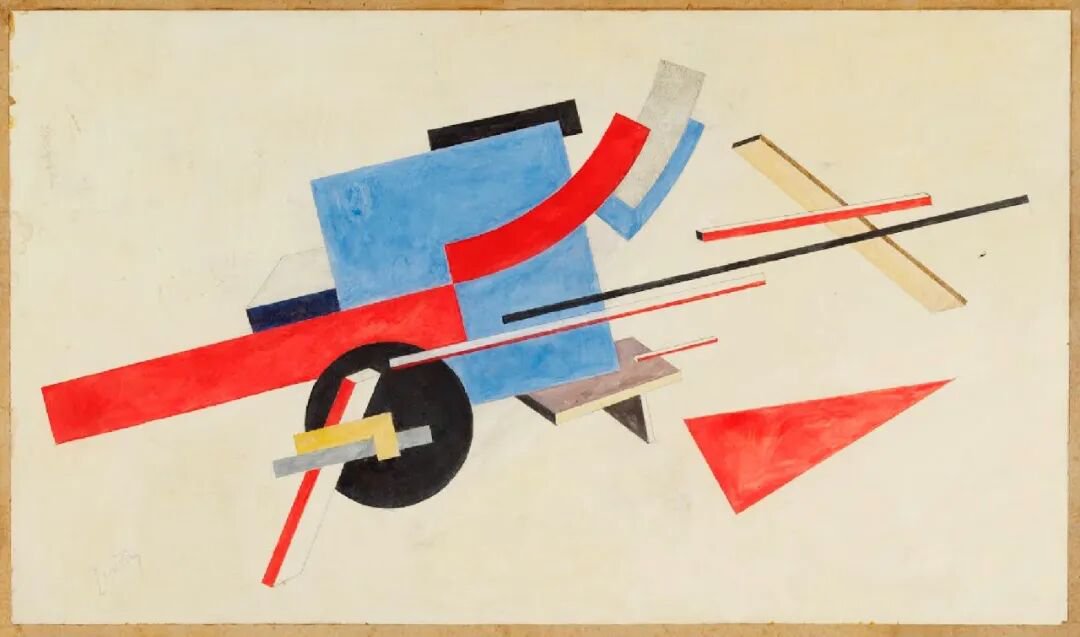 El Lissitzky, 1923
Ready? Let us begin with a strange claim made by a mathematician.
Starting with Hilbert
The mathematician Hilbert once said something like this. In every geometric proposition, "we must always be able to replace 'points, lines, planes' with 'tables, chairs, and beer mugs'." In other words, the first axiom of geometry, "any two points can be joined by a straight line," could be rewritten as "any two beer mugs can be set down on one table."
The claim sounds a bit baffling, doesn't it. "Point, line, plane" are concepts so deeply rooted that it is hard even to picture a geometric proposition without them. I can maybe imagine "two points lie on one line" as the image of "two beer mugs set down on one table," but the moment I hit a harder sentence (say, "two straight lines divide a plane into at most four parts"), the whole translation machinery seems to crash on the spot. Two chairs set on one table? Or two tables stacked up on top of one chair? And where on earth do all those beer mugs go? The picture in my head turns into chaos, a little seaside bar that a tornado has just torn through, tables and chairs heaped into a hill, the floor a field of broken glass. You want to drag our dear Professor Hilbert over and say to his face, "Please, just tell me, how exactly does this replacing work, because I really cannot make sense of it!"
As a fan of Professor Hilbert, I will be so bold as to come to his rescue. Reader, you do not have to cling to the mug-chair-table picture. Open the frame a little wider. How about swapping "point, line, plane" for "rice noodle rolls, rice vermicelli, soup dumplings"? Or "happiness, sadness, fear"? Or just drop the words altogether and use "X, Y, Z"? Any of them works, because the only thing we need to care about is the relationships between concepts, not the words we use to name those concepts. And so, as long as X, Y, Z satisfy the handful of rules of geometry, as long as the rules and relations among them are pinned down, it makes no difference at all what words we use to call them. This way of thinking is what I call the "axiomatic structuralist approach."
Professor Hilbert was called a leader of world mathematics in the early twentieth century precisely because he raised the banner and pushed forward an enterprise called "the axiomatization of mathematics." In his ideal, there exists a "list of rules." This list contains all the most basic rules that any piece of mathematical research could ever need, rules that are self-evident and also impossible to prove (these are called "axioms" or "postulates"). From these rules one can derive, in principle, every mathematical truth (every true proposition) there is. Later mathematicians would only have to follow this set of rules honestly, and sooner or later the field would be able to prove every objective truth, and humanity's dream of absolute truth, a dream running back to the ancient Greeks, would at last come true. Hilbert's ringing line still echoes in my ears: "We must know. We will know!" Two short sentences, and yet they carry the same vast spirit as the old Chinese vow to "establish a heart for heaven and earth, secure life for the people, carry on the lost learning of past sages, and open up peace for ten thousand generations."
It is a pity that the lovely dream of axiomatization had several buckets of cold water poured over it, hemmed in by Turing's "halting problem" (there is no algorithm that can decide whether a given proposition can be proved from the axioms in a finite number of steps) and Gödel's "incompleteness theorem" (any formal system that contains the Peano axioms will contain true propositions that cannot be proved). The "third crisis in mathematics" is a fascinating story, but in this essay let us keep our attention trained on the "axiomatic structuralist approach." I will save the tale from the history of mathematics to tell you properly another time.
Words and structuralism
Here I want to turn the reader's gaze toward "structuralism" and think through, together with me, a single question: what exactly is a word?
We are all human, and the ancient Greek sage Aristotle called us "the animal that speaks." Whether you study philosophy or mathematics, whether you work in sales or in engineering, our working lives all seem to come down to "talking" and "writing," that is, to using language. But language alone is not quite enough. An artist pouring talent onto a building or a canvas does not seem to need language, and a religious figure preparing a space and the materials for a ritual can apparently do without it too, so language does not make up the whole of our lives. And yet these people are certainly using "symbols." They have to convey their thoughts and feelings through shape, color, form, and gesture. So we can push this one step further and say that every kind of human intellectual activity is "the use of symbols," that our knowledge and our ideas form a "system of symbols," and that social rules and logical reasoning both belong to a single "symbolic order."
Nonverbal symbols cannot be explained to you through words alone, so for the sake of the writing let us stick to "language" and "words." Wittgenstein, one of the founders of analytic philosophy, used chess as a metaphor for language in his late work Philosophical Investigations. Words are the chess pieces, and the rules for using language are the rules of the game of chess. Suppose a chess "rook" rolls onto the floor and goes missing. I put a small stone of about the right size on the board, and you and I both know that this stone is the "rook" (because we use the stone according to the game rules for the "rook" in chess), and so the two of us can happily finish the game.
Following this line of thought, a great many puzzles in science suddenly dissolve. A physicist can create the concept of the "electron" without having to labor over questions like "what is an electron? does the electron exist?" To use the word "electron," all we need is for it to sit comfortably alongside other physical concepts and to obey a series of definitions and rules in physics. Whether it is a little ball orbiting the nucleus or a cloud of probability surrounding the nucleus, these questions are of course worth investigating, but they do not stop me from using the concept "electron" at a higher level, say in a nuclear reaction equation or in chemistry.
I used to be deeply, deeply confused. "If the electron is a cloud of probability, then how do I make sense of a sentence like 'there are two electrons outside the nucleus,' and what does 'gaining and losing electrons' in chemistry even mean? I know we can redescribe it more precisely with the overlap and the shift of electron clouds, but is this still the same 'electron' we set out to study? The definitions of these terms have changed so completely. Can we still be sure that the thing we are describing with the term is the same object?" Think these questions over and they really can make your skin crawl. They surface every so often while you are poring over a textbook or buried in a stack of problem sets. Sadly, almost nobody raises them, and even when a student works up the courage and the words to ask a teacher, it is hard to get an answer that truly sets the mind at rest.
Taking up the "structuralist" way of thinking, we finally get our hands on a theoretical tool that can answer these questions. As long as we speak according to the agreed-upon rules, we can perfectly legitimately use a word within a system, without having to fret too much over what the "essence" of the concept that word points to actually is.
Letting go of the fixation on essence
The thoughtful reader is bound to object: how can you say "essence" does not matter? Isn't science precisely the study of essences? But as I see it, letting go of the fixation on "essence" is something we do because we have no other choice. Here are my reasons.
Physics has now reached a point where we have to admit the limits of our imagination. Just as even the most gifted illustrator of fantasy tales cannot create an animal with no features at all drawn from real-world creatures (look closely at things as outlandish as the chimera and the Chinese dragon, and they too are pieced together from the templates of real animals), we cannot use imagination to "see" a physical entity. Scientists argued themselves hoarse over whether "light" is a wave or a particle, and in my view the source of their dispute is simply an unwillingness to admit that "light" is something we cannot picture using the everyday objects we see around us.
For the concept of "light," whether we call it a probability cloud, a solid little ball, or a wave function, we can write down equations and even draw diagrams, but we have to admit that these things are at best a reflection of, or an approximation to, the "light" of reality. They cannot possibly be, one to one, the thing called "light" itself. So we are driven to say "light has wave-particle duality." This does not mean that "light" is at once a "wave" and a "particle," because saying it that way commits an enormous error. We would be assuming in advance that the reality of matter is something similar to the "waves" and "particles" we see in our daily lives, instead of daring to imagine that the reality of matter is something wholly cut off from common sense, something that cannot be grasped by direct intuition.
This is exactly the moment for our "structuralist approach" to make its grand entrance. How do we use the structuralist methodology to understand the "wave-particle duality" of "light"?
In physics, when we say X is a "particle," all we are really saying is that this X satisfies the rules for using the word "particle" (for instance that it is indivisible, that it bounces back, that it occupies a certain amount of space, all in line with the definition of a particle in physics). The same goes for "wave" (it can spread out across the whole of space, in line with the definition of a wave in physics). So when we say "light" has wave-particle duality, all we are really saying is that "light" can satisfy a little of the usage rules for "wave" and a little of the usage rules for "particle." As long as this whole system of rules can run in a self-consistent and stable way, we can know perfectly well what properties this thing called "light" will display in experiments, and how "light" can be put to use in engineering. And the great aims of science, to be confirmable by experiment, to hold universally, to explain the past and predict the future, have at this point all been met.
The attentive reader may not be satisfied with the explanation above and will keep pressing, stubbornly: "Hold on. You have just talked your way in a circle around 'light' and still have not told me what the essence of light actually is."
But if I ask you what "essence" means, would you not also be stuck for a moment, unable to answer? Yes. In the context of "structuralism," the question "what is the essence of a thing?" (in philosophy this is called the "ontological question" or the "metaphysical question") turns out instead to be an illegitimate one, because everything our talk can reach has been reassigned to the use of linguistic rules, with no regard at all for the words in themselves. A noun standing all alone has no meaning whatsoever. Only when it is placed inside a web of meaning made up of the mutual relations among words (the usage rules) can a word be understood and felt.
A short summary
In Ersilia, to establish the relationships that sustain the city's life, the inhabitants stretch strings from the corners of the houses, white or black or gray or black-and-white according to whether they mark a relationship of blood, of trade, of authority, of agency. When the strings become so numerous that you can no longer pass among them, the inhabitants leave: the houses are dismantled; only the strings and their supports remain.
From a mountainside, camping with their household goods, Ersilia's refugees look at the labyrinth of taut strings and poles that rise in the plain. That is the city of Ersilia still, and they are nothing.
They rebuild Ersilia elsewhere. They weave a similar pattern of strings which they would like to be more complex and at the same time more regular than the other. Then they abandon it and take themselves and their houses still farther away.
And so, traveling in the territory of Ersilia, you come upon the ruins of abandoned cities, without the walls which do not last, without the bones of the dead which the wind rolls away: spiderwebs of intricate relationships seeking a form.
from Invisible Cities by Italo Calvino
"Without the walls which do not last, without the bones of the dead which the wind rolls away: spiderwebs of intricate relationships seeking a form." This little fable of a city is Calvino's wildly romantic literary expression of structuralism. The words we use from day to day are no more than crumbling, perishable ruins. What truly matters, what alone matters, is not the "things" but the "form."
"Structuralism" holds an important place in the history of philosophy and linguistics, but exactly what kind of claim this "ism" stands for has never been clearly settled in the academic world. So it is fair to say that the "structuralism" I lay out in this essay is not an interpretation or a retelling of some existing body of thought. It contains my own original take and understanding.
We are better off understanding "structuralism" as a method rather than a position. It holds that the essence and the meaning of a thing live inside its "structure." "Structure" here is a synonym for "form," "rule," and "system." It means the network woven out of the wide-ranging connections among countless things. I often feel that the word "formalism" would fit better and be easier to grasp, but "formalism" has already been widely used to mock bureaucratic red tape and pointless showmanship, so I had no choice but to drop the idea, a little reluctantly.
I said above that "structuralism" does not care about "essence." That is correct, and yet not entirely correct. It would be better to say that structuralism is pursuing the "essence" of things by a different road. It holds that the "essence" of a thing exists in, and shows itself only through, the structure among things. It holds that anything has meaning only inside a system, and that pulling it out of the system to talk about it on its own has no meaning at all. So it denies the "essence" of any single thing. Whether it is "vector," "atom," "fairness," or "freedom," no single word has any meaning. A word has meaning, and can therefore be understood, only when it is placed in context.
To sum up structuralism in one line: a word has meaning only in context. And so the sum of the parts is greater than the whole, while the whole is what gives the parts their meaning.
Then why did I write "wisdom condenses inside words" in the title? I will leave that hanging, as a bit of suspense and a question to chew on. In the next piece of this series, I will explain it to you in detail.
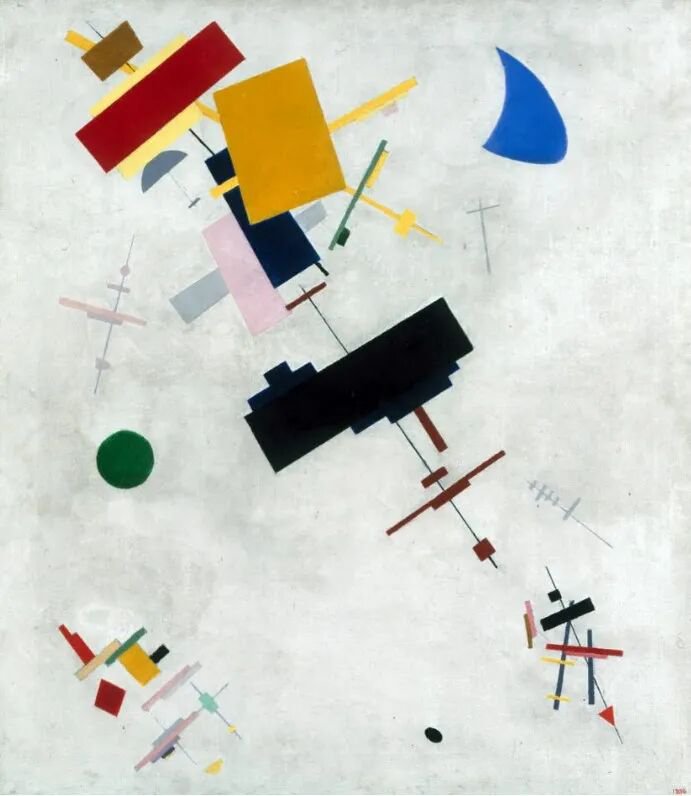 Malevich, 1915
I am Ning Ning Ning Jing Hai. Thank you for reading to the end.
References:
Books
- Philosophical Investigations by Wittgenstein
- Science, Philosophy, Common Sense by Chen Jiaying
- Invisible Cities by Italo Calvino
Web
凝结在语词里的智慧(一)结构主义
书写是为了更好地思考。
人非圣贤,正是因为单个人的想法总是有漏洞,才值得拿出来交流,被别人指出问题正是改进的空间,藏着掖着的想法永远不可能变得更成熟。
我喜欢思考,有些想法如果不及时记录下来,也就这样忘掉了,非常可惜。所以新开一个系列,名曰"随想",旨在理顺思路,记录想法,以供自我反思和相互交流之便。
埃尔·利西茨基,1923
准备好了吗?让我们从一位数学家的奇特主张谈起吧。
从希尔伯特谈起
数学家希尔伯特曾言——
(在一切几何命题中)"我们必定可以用桌子、椅子和啤酒杯来代替点、线、面。"也就是说,几何学的第一公理"任意两个点可以通过一条直线连接"可以改写为"任意两个啤酒杯都可以放在一张桌子上"。
这个主张听起来有些摸不着头脑,对吧。"点线面"是如此根深蒂固的基本概念,以至于我们甚至很难离开它去想象几何命题。我或许能够把"两个点在一条直线上"想象成"两个啤酒杯被摆在一张桌子上"的画面,但遇到更困难的句子(比如"两条直线最多能将一个平面分成四个部分"),这个"翻译机制"好像一下子就宕机了,把两个椅子摆在一张桌子上?或者说把两个桌子架起来叠在一个椅子上边?还有一堆的啤酒杯该摆在哪里?脑海里的想象乱成一团,活生生一个被龙卷风刮过的海边小酒吧,桌子椅子胡乱堆成小山,地上满是碎啤酒杯玻璃碴子。恨不得拉来我们亲爱的希尔伯特老师,当面对他说:"您给说说,到底怎么个代替法,我可想不明白!"
作为希尔伯特老师的粉丝,我斗胆来帮希老师解个围。请读者不必拘泥于"杯椅桌"的想象,不妨再把格局打开,把"点线面"换成"肠粉、米线、小笼包"怎么样?或者"开心、伤心、恐惧",如何?要么就干脆连文字也不要了,换成"X、Y、Z",又如何?其实都行得通,因为我们需要关注的只有"概念之间的关系",而不是"用什么词语去称呼概念"。于是乎,只要 X、Y、Z 满足了几何学的几条规则,彼此之间的规则和关系被确定下来了,那么用什么词汇去称呼它都是无所谓的,这一思想方法论被我称之为"公理化结构主义路径"。
希尔伯特老师被称为 20 世纪初的世界数学领袖,正是因为他高举大旗推进一个叫做"数学的公理化"的事业。在希老师的理想之中,存在着一个"规则列表",这个列表里边包含了所有数学研究会用到的最基本的、不证自明也无法被证明的规则(这些规则被称为"公理"或者"公设"),然后用这些规则可以推导出理论上所有存在的数学真理(真命题),这样后世数学家只要老老实实按着这套规则来,那么数学界迟早能够证明所有的客观真理,自从古希腊以来人类对于绝对真理之梦也将终将实现。希尔伯特老师那句振聋发聩的"我们必须知道,我们必将知道!"犹在耳畔。短短两句,有"为天地立心,为生民立命,为往圣继绝学,为万世开太平"的大气势。
很可惜,在图灵老师的 "停机问题"(不存在"能够判定一个命题能不能用公理在有限步骤内证明出来"的算法)和哥德尔老师的 "不完备性定理"(一个形式系统只要包含皮亚诺公理,就会存在不能被证明的真命题)的合围下,公理化的美好梦想被狠狠浇了几盆冷水。"第三次数学危机"是个很有趣的故事,但在这篇文章里我们还是把问题意识收束到"公理化结构主义路径"上,数学史故事留到以后再给你好好叙叙。
语词和结构主义
在这里,我想请读者把目光放到"结构主义"上,同笔者一起思考这样一个问题:"到底什么是语词?"
我们都是人类,古希腊先哲亚里士多德老师称人是"会说话的动物",甭管是研究哲学还是数学,做销售还是技术,我们的工作生活似乎都可以归结到"说话"、"写字"上面,也就是"运用语言"。但光"语言"还不够——艺术家在建筑与画布上挥洒才情似乎用不到语言,宗教家准备场所和素材举行仪式似乎也可以不用语言,可见语言也不构成我们生活的全部。但他们也一定会用到"符号",一定需要通过图形、色彩、形式、动作,传达自己的思想和情绪。于是我们可以再推广一步,称所有一切人类智性活动都是"运用符号",称我们的知识和观念是一个"符号系统",称社会规则和逻辑推理都同属于"符号秩序"。
非语言的符号无法用单单用文字解释给你听,于是为行文之便,我们来讨论"语言"和"语词"。分析哲学的创始人之一维特根斯坦老师在他晚期的著作《哲学研究》里拿象棋来比喻语言——语词就是棋子,而语言的使用规则就是象棋的游戏规则。象棋里的一个"车"掉地上找不到了,我拿个大小合适的小石块放在棋盘上,你我都知道这个石块就是"车"(因为我们运用象棋中"车"的游戏规则来使用这个石块),那么这样你我还是能快快乐乐下完这盘棋。
如此,沿着这条思路,科学里的很多迷思很快就可以解决了,物理学家可以创造"电子"的概念,而同时不需要费力去回答"什么是电子?电子是否存在?"这些问题。因为我们使用"电子"这个词只需要它和其他物理概念相互融洽,符合一系列物理学上的定义和规则就足够了,至于它是绕着原子核旋转的小球,还是围着原子核的一层概率云,这些问题当然值得考究,但却并不影响我在一个更上层的视角(比如在核反应方程式或者化学当中)去使用"电子"这个概念。
我曾经非常非常地困惑,"电子是概率云,那么我怎么去理解'原子核外有两个电子'这样的句子,化学里的'得失电子'又是什么意思呢?我知道我们可以用电子云重叠和偏移去重新更精确地描述它,但这还是原来我们研究的那个'电子'吗?我们对于这些术语的定义发生了如此天翻地覆的变化,我们还能确定我们用这个术语描述的是同一个对象吗?"这些问题仔细想想真是叫人不寒而栗,当我们研读教材、埋头题海的时候,时不时就会浮现到脑海中。可惜的是,这些问题鲜有人提,就算学生组织好语言鼓起勇气向老师提问,也很难得到令人心服口服的答案。
采取"结构主义"的思维方法,我们终于获得了可以回答上述问题的理论利器——只要我们按照公认的规则说话,我们完全可以合理合法地在一个系统里使用词汇,而全然不用去过度关心这个词汇所指向的概念的"本质"是什么。
放下对"本质"的执念
爱思考的读者肯定不服气,怎么能说"本质"不重要呢?科学不就是在研究本质吗?但在笔者看来,放下对于"本质"的执念是不得已而为之,下面给出理由:
物理学发展到如今这个地步,我们必须承认我们想象力的局限性,正如再天才的奇幻故事插图画家也没法创作出一个完全没有现实世界生物特征的动物(怪异如奇美拉和中国龙,细细考究,也是由现实动物的原型拼凑出来的),我们也无法通过想象力去"看见"物理实体。科学家为"光"是波还是粒子吵得不可开交,在我看来,他们的争议之源是不愿去承认"光"是一个我们无法用日常所见之物去想象的东西罢了。
对于"光"这个概念,不管是概率云、实心小球还是波函数,我们可以写出方程式甚至画出示意图,但是我们必须承认,这些东西顶多可以算作一种对于现实中"光"的一种反映或者近似,却不可能完全一比一地就是"光"这个东西。于是我们不得已说"光有波粒二象性",这并不是说"光"同时是"波"和"粒子",因为如果我们这么说犯了一个天大的错误——我们预先假设了物质的实在和我们生活里看到的"波"和"粒子"是类似的东西,而不敢去设想物质的实在是完全脱离常识的不可直观理解之物。
这个时候就轮到我们的"结构主义路径"堂堂亮相啦,怎么用结构主义的方法论去理解"光"的"波粒二象性"呢?
在物理学里,我们说 X 是一个"粒子"的时候,无外乎是在说一个这个 X 满足了我们使用"粒子"这个词汇的规则(比如不可分割、会反弹、占据一定空间,符合物理学里对粒子的定义)。对于"波"也是一样(可以弥散在整个空间当中,符合物理学里对波的定义)。于是当我们说"光"有波粒二象性的时候,也无外乎是在说"光"既能符合一点儿"波"的语用规则,又能符合一点儿"粒子"的语用规则罢了。只要这一套规则系统能够自洽稳定的运行,那么我们完全可以知道这么个叫做"光"的东西在实验里会呈现出什么样的性质,在工程上又能怎样应用"光"。那么科学的几大目的——"可被实验证实、有普遍性、能解释过去和预测未来"——到这里已经全部完成了。
细心的读者或许不会对上述的解释感到满意,还是会想不屈不挠地要追问:"且慢,你只是绕着'光'说了一圈,却还没有告诉我,光的本质到底是什么?"
但是如果我问你"本质"是什么意思,你是不是也会一时语塞,答不上来呢。是的,在"结构主义"的语境下,"事物的本质是什么?"(这一问题在哲学上被称作"本体论问题"或者"形而上学问题")反而成了一个非法提问了,因为我们言谈之所及全部被划归为了语言规则的使用,而全然不在乎语词本身。一个孤零零的名词没有任何意义,只有放在一个由语词之间的相互关系(语用规则)组成的意义网络当中,一个词汇才可以被理解、被体会。
小结
我在艾尔西里亚,为了建立维系城市生命的关系,居民都在房屋角落之间拉起黑、白、灰或黑白色的绳子,绳子颜色视彼此亲缘、交易、权威和代表关系而定。当绳子多到让人连路都走不通时,居民们就会搬迁,拆掉房屋,只留下绳子及其支撑物。
带着家中器具露宿山坡的艾尔西里亚难民们,回望平原上那些由竖起的木桩和木桩间拉起的绳索构成的迷宫。那里仍是艾尔西里亚城,而他们则算不上什么。
他们在另一处再建艾尔西里亚,要编织另一张类似的绳网,但更加复杂,更加有规则。后来,他们再度离弃那里,把家搬到更远的地方。
于是,当你在艾尔西里亚境内旅行时,会看到一处处被遗弃的旧城废墟,不耐久的墙壁早已消失,死者的骸骨也早已被风吹走:只有那些交织纠缠着的关系的蛛网在寻找一种形式。
——《看不见的城市》伊塔洛·卡尔维诺
"不耐久的墙壁早已消失,死者的骸骨也已经被风吹走,只有交织纠缠着的关系的蛛网在寻找一种形式。"卡尔维诺的这一小段城市寓言是对结构主义极浪漫的文学表述。我们日常所用的语词,不过是流变而易逝的残垣断壁罢了,真正重要而且唯一重要的,不是"事物",而是"形式"。
"结构主义"在哲学语言学史上有着重要的地位,但这个"主义"到底指什么样的一种主张,在学界却没有明晰的界定,所以可以说,我在本文阐述的"结构主义"并不是对于既有思想的阐释与重述,而是包含了我自己的原创与理解。
我们更应该把"结构主义"理解成一个方法而不是一个立场。 它认为事物的本质和意义存在于"结构"之中。这里的"结构"是"形式"、"规则"、"系统"的同义词,它意味着万千事物之间广泛联系交织起的网络。我常觉得"形式主义"这个词才更为恰当,更好理解,无奈"形式主义"已经被广泛用于讽刺官僚主义的繁文缛节和无用作秀,只能悻悻作罢。
上文说"结构主义"不关心"本质",这是正确的,但却也不完全正确,其实不如说是结构主义在另辟蹊径地追求事物的"本质",它认为事物的"本质"只存在并体现于事物之间的结构当中,认为任何东西只有在一个系统里才有意义,把它独立出系统单独谈论没有任何意义,于是这就否认了任何单个事物的"本质",甭管是"向量""原子"还是"公平""自由",任何单一的词汇都没有意义,只有放在语境里才有意义因而能被理解。
用一句话来概括结构主义,就是 "语词只有在语境里才有意义",因此局部的总和大于整体,整体为局部赋予意义。
那么为什么我还要在标题里写"智慧凝结在语词中"呢?留个悬念,也当作思考题,在这个系列的下一篇文章里,我再来给你细细讲解。
马列维奇,1915
我是宁宁宁静海,感谢你看完我的文章
参考资料:
【著书】
- 《哲学研究》by 维特根斯坦
- 《科学·哲学·常识》by 陈嘉映
- 《看不见的城市》by 伊塔洛·卡尔维诺
【网页】