Knowing the World Anew (I): The Real, the Symbolic, the Imaginary
The seed of this piece was planted a long time ago. With a little free time lately, I finally sat down to write it out.
The original idea was to braid together posthumanist theory and the line of thought running through Lacan and Žižek, fold in a concept I call the Digital Order, and from all of that sketch a fuller picture of the modern and near-future world.
But as I wrote, the word count kept swelling. What started as a hundred-word memo grew, even when I stuck to the essentials, into something close to a ten-thousand-word philosophical essay. It made more sense to break it into several posts.
By rights, Žižek's thought deserves ten times this much space to be properly unpacked and explained. But that is not the center of gravity for what I want to discuss in this series, Knowing the World Anew. So here I only gesture at it, as a way to start a conversation and lay down some background.
They say the world was chaos at first, and the world took shape under the poet's pen.
from Chen Jiaying, Perception, Reason, and Self-Knowledge
Lacan and Žižek divide the subject into three registers:
- the Imaginary Order
- the Symbolic Order
- the Real
A human subject's knowledge of itself is always indirect. We have no way to know ourselves directly. We can only come to know ourselves through the feedback loop of interacting with the outside world.
We look at ourselves in mirrors and cameras to learn what our faces look like. We build a sense of our current self and our ideal self through external systems of judgment and moral exemplars.
So we end up taking the observed, objectified self for the real self. This misrecognition of the self is what constructs our self-knowledge, and because the misrecognition is rooted deep in our minds, this is the Imaginary Order.
The Symbolic Order, or the order of signs, is a world built entirely by human beings.
Symbols are language in the broad sense, and the discussion of signs and language has been the center of gravity for modern philosophy. Saussure's structuralist linguistics holds that a sign has two parts: the signifier and the signified.
The signifier is the sign's image or sound-form. The signified is the concept being expressed.
The signifier lives in the Symbolic Order, while the signified sits in the real world.
A classic example is this proposition:
"Snow is white" if and only if snow is white.
The first clause is the signifier, the symbol written on paper or the sound spoken aloud. The second is the signified, the snow in the real world showing up white.
Much of later philosophy and sociology is built on reading and interpreting signs. Take Baudrillard's critique in The Consumer Society: the consumption of objects no longer rests on their use-value but on their sign-value. To turn something into a sign is to turn it into a commodity, and commodity-signs form an endless chain of signs and meanings. The body, experience, relationships, status, all of it gets sign-ified and folded into the order of commodities.
The Symbolic Order is false, and also not false. It contains the whole of what we might call "the real as confirmed by signs."
J.L. Austin, of the ordinary-language school, proposed the influential theory of the speech act: some utterances are equivalent to the act itself, and an act has effects on the world.
Take marriage. The process is entirely verbal. The pronouncement of the marriage is the marrying itself. Nothing in the real world changes, yet the social relation between two people, and the rest of their lives, will be different from before. This is because the Symbolic Order, though it has nothing to do with the real world, is the world we humans have been forced to dwell in from the moment we acquired self-consciousness and language. Social relations, nations and peoples, property rights and human rights, language and signs, all of these exist, and exist only, in the Symbolic Order.
If you want to understand why entities like nations and societies also exist only within the Symbolic Order, go read Imagined Communities. I will not belabor it here.
Now for the Real, the hardest and most subtle part of Lacan and Žižek's theory.
You have actually already met the Real in what came before. It is that "real world" I kept invoking. The Real is the truth of the world, the chaos that has not yet been carved up by symbolic cognition.
Hayek argued that the basic function of the brain is to classify things. To classify is to name things in order to mark off the differences between one thing and another, which is to say, it is the process of sign-ifying the world. But between one thing and another there is no inherent boundary. The boundary is human-made, and it lives in the Symbolic Order.
When I see an animal's tracks in the snow, I will say they are "footprints." But for a small insect, they are not "footprints," they are "the rise and fall of the terrain." Our cognition of the world comes pre-loaded with an understanding of it, which is why understanding the world as another person or another creature sees it is harder than we tend to imagine.
Of course, "terrain" and "rise and fall" are not good enough descriptions either, because those words are concepts in the human language system. They already carry our basic cognitive model of things, and they likewise do not exist in the insect's cognition.
From this example we can see that the Real cannot be felt or known, because any act of cognition is a process of sign-ifying and structuring, and that process belongs to the Symbolic Order, not the Real.
Seen through the lens of evolution, a sign system or a system of ideas comes from an organism adapting to the rewards and punishments of its surroundings. So an organism's environment reaches back and prescribes how its signs are used and what they mean. This sits comfortably alongside Wittgenstein's remark that "to imagine a language means to imagine a form of life."
The Real is the world before it is known. In the terms Heidegger uses for Being in Being and Time, the Real is the world in the absence of "Dasein." To put it in a not-quite-fitting metaphor: the real world is itself a kind of gray, and the presence of a conscious subject lights it up. But the observed world is not entirely equivalent to the world before it was observed. The presence of the observer, the conscious subject (which is to say "I," "Dasein"), cannot be ignored.
The Real comes close to the physical world that modern science has disenchanted: no nations or societies running their course, no human joys or sorrows, only the mechanical universe of elementary particles in motion.
But the Real is more chaotic, more primordial, than the world in a physicist's eye, because signs like "electron" and "photon" are not allowed there. Even mathematical laws are not admitted into the Real, since mathematics is a formal language.
The theory-ladenness of observation is a famous thesis in the philosophy of science. Observation has to rest on theory. Behind the method, the object, and the aim of any observation there is always some conceptual support. So theory seeps into observation and changes what it finds, which makes objective observation an impossibility.
To run a physics experiment, I necessarily need some premise and intention that lets the experiment happen at all, and that intention seeps into my experiment. So a detached, objective experimental result does not exist. Put strictly, science does not transcend experience.
The theory-ladenness of observation also lays bare something more frightening: objective history does not exist either, which is the impossibility built into the discipline of history. Croce said "all history is contemporary history," and Benjamin Schwartz reopened his book The World of Thought in Ancient China by restating it: "the history of the past is inevitably and always the history of the present." This is a return to humane concern and an attention to the problems of the present day. It is also the historian flinching away from the problem of the Real.
In the sciences we can see a similar flinch. In The Structure of Scientific Revolutions, Thomas Kuhn proposed his widely circulated concept of the paradigm. A paradigm is something like a "namespace" in a programming language. Scientific conclusions are always conclusions under a given paradigm, and within the scope of that paradigm they are correct. There is no denying the value of the paradigm as a guide to scientific research, but the incommensurability between paradigms has become a sticking point hard to resolve. Kuhn's account of whether relativity overturned Newtonian mechanics is that the two understand and define space and time differently, so each is correct within its own paradigm. That argument is not wrong, but it offers no guidance on how to reconcile and mediate the differences between paradigms, and it does not face up to the subtle influence of human cognition and vocabulary on scientific research. (Newton and Einstein may define space and time differently, but the words they use are the same.)
In 1972, Philip Anderson, a founder of condensed matter physics and a Nobel laureate, published a semi-philosophical paper in Nature titled More is Different, which went deep into the hierarchical structure of science:
elementary particle physics, condensed matter physics, chemistry, molecular biology, cell biology, physiology, psychology, the social sciences. Across these layers, the entities at each level have to obey the laws of the level above them, yet at every level we still have to find new concepts, definitions, laws, and principles, and these cannot simply be deduced from the level above. A change in scale produces a qualitative change in theory, a phenomenon now widely called emergence.
From a naive reductionist view, if we grasped the properties of the most basic matter, then the more macroscopic properties ought to be "derivable." In practice, though, bridging the gaps between the layers has become one of modern science's hard problems. We have gained sharp tools like statistical mechanics and network science, but the theoretical chasms between disciplines are far from filled.
Hayek, the Nobel economist, and Qian Xuesen, whom we know well, both turned their later scholarly interests toward complex systems theory. I suspect they both sensed the same cloud that hangs over all theory: the very nature of the Real means it cannot be structured or sign-ified in any form, and the attempt to sign-ify it often leaves behind a remainder that cannot be sign-ified. This shows up as Arrow's impossibility theorem in voting theory, Gödel's incompleteness theorems in mathematics, and emergent properties in complexity science.
A small preview: from a more contemporary vantage, these striking "impossibilities" cannot be credited entirely to the fissures of the Real within the Symbolic Order. They also owe something to the encroachment of the Digital Order upon the order of feeling and speech.
Did two new terms appearing out of nowhere just startle you? Don't worry. The matter of the Digital Order is something we will unfold slowly in a later piece.
The Welsh poet R.S. Thomas wrote in his poem "Reflections":
The furies are at home in the mirror; it is their address.
Even the clearest water, if it goes deep enough, can drown you.
from R.S. Thomas, "Reflections"
The furies in the poem are the specter of the Real. They are the incompleteness internal to the Symbolic Order. The subject of the Real is usurped and assassinated by its sign-ified identity in the Symbolic Order, and this murdered subject becomes a vengeful specter, tearing rift after rift into the Symbolic Order.
To borrow a line from Guy Debord's The Society of the Spectacle: "In a world truly turned upside down, the true is a moment of the false." This inverted world is the Symbolic Order, and the truth of the Real can only show itself in the moments when the Symbolic Order contradicts itself.
(A small note: my "borrowing" from Debord above is in fact an instance of his Situationist concept of détournement. The notion of the spectacle was itself a détournement of capital from Marx's Capital, and my reading of Debord here is a second détournement.)
Camus caught hold of this well in his work and called it the absurd. The feeling of the absurd comes precisely from the incompleteness of the symbolic order. When a person, as an actor, feels estranged from the stage of the world, they taste that absurdity.
Seen in the fullest picture, even war and the hero contain a contradiction.
A nation can go to war only once it finds the other side that recognizes the conflict, so each side is necessarily and intricately entangled with the other:
Before I can have an enemy, I must persuade that person to regard me as an enemy.
And I cannot become a hero unless I first find someone who will threaten my life, even take it.
from James P. Carse, Finite and Infinite Games
The Symbolic Order is theatrical. Every concept has to depend on its opposite. In a concrete context a word has a precise, perceptible meaning, but in the abstract arena of discourse it is forced to lean on its opposing concept.
The slogan of "justice" comes from a hatred of and revolt against "injustice." But if there were no justice and no injustice in the world at all, then the pursuit of "justice" would naturally fall into absurdity.
In Genesis, Jehovah warns the first man, Adam: "But of the tree of the knowledge of good and evil, thou shalt not eat of it, for in the day that thou eatest thereof thou shalt surely die." The forbidden fruit that Adam and Eve ate is exactly this fruit of the knowledge of good and evil.
In the Real there is neither good nor evil. The division of good and evil lives in the Symbolic Order. Following this reading, the human beings who can tell good from evil (the Symbolic Order) are naturally cast out of the whole and harmonious garden of Eden (the Real) and sentenced to exile. The "surely die" is the death of the human subject of the Real. We cannot face the chaotic, true Real, and can only live in the theatrical Symbolic Order.
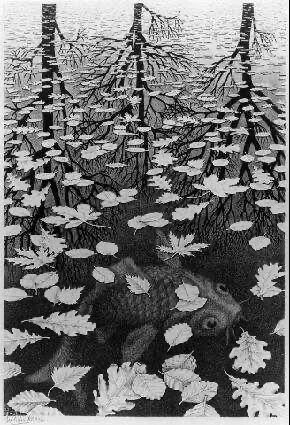 M.C. Escher, Three Worlds, lithograph, 1955
The discussion of Lacan's three orders could go on. But since this is not the center of gravity for what I want to talk about, and since there is little here that is original to me, I will stop at a gesture and leave it here.
In the next piece we will bring in the lens of posthumanist theory and discuss the relationship between the Analog and the Digital. Stay tuned.
References
This piece really did not need a references section, since every theorist and book I needed to mention is already named in the text.
But I still want to mention Yusizhou of Gcores, and these three detailed introductions to Žižek. It was these articles that first brought me to Žižek and his theory, that gave me a handhold on theory in the middle of all the chaos. I am sincerely grateful for Yusizhou's writing.
The titles and links to those three pieces are below. I recommend them wholeheartedly.
- Yusizhou: Disco Elysium and Žižek (1): The Most Dazzling Disco-Ball Philosopher
- Yusizhou: Disco Elysium and Žižek (2): The Academic Influencer and Carrier of Red Ink
- Yusizhou: Disco Elysium and Žižek (3): What on Earth Is the Mirror Saying?
I am Lunar Mare. Thank you for reading.
You are welcome to reach me by any means. My email is lunar_mare_official@outlook.com. Write to me and let's talk, I reply to every message. :)
重新认识世界(一):实在界 象征界 想象界
这篇文章内容的灵感来自于很久以前,近日稍有闲暇,便来落笔成文。
最开始的想法,是结合后人类理论和拉康齐泽克的思路,把「数字界」的概念糅合进去,从而给现代和近未来世界描画出一个更完整的图景。
写着写着,字数不断膨胀,从最开始百来字的一则 memo,即使只挑着重点写,也慢慢变成了接近上万字的哲学小论文,拆分成多篇文章推送更为合适。
按说齐泽克的思想应该要用十倍以上的文字量来加以更详细的解释和阐述。但这并不是笔者在《重新认识世界》中想要讨论的重心,所以本文点到为止,仅作抛砖引玉和背景介绍之用。
据说,世界本来是混沌的,世界在诗人的笔下成形。
——陈嘉映《感知·理知·自我认知》
拉康和齐泽克将主体分为三个纬度:
- 想象界(Imaginary Order)
- 象征界(Symbolic Order)
- 实在界(The Real)
人类主体对自我的认知永远是间接的,人没有办法直接认识自我,必须借由和外部世界的互动反馈来认知自我。
人看向镜子和摄像机里的自己来认识自己的相貌,通过外部的评价体系和道德模范来建立对当前自我和理想自我的认知。
于是,人将被审视的、客体化的自我当作了真正的自己,这种对自我的误认构建了人的自我认知,这一误认根植于我们的思想中,即为「想象界」。
「象征界」,或者说符号界,是完全由人构建出来的世界。
象征(符号)是广义的语言,关于符号与语言的讨论是近代哲学界的重心。索绪尔的结构主义现代语言学指出,符号由两部分组成——能指和所指。
能指是符号的图像或声音形象,而所指是被表达的概念本身。
能指在象征界中,而所指则位于真实世界。
典型的例子是下面这个命题:
“雪是白的”,当且仅当雪是白的。
前一句是能指——写在纸上的符号或被发出的声音,而后一句是所知——真实世界中的雪花呈现出白的颜色。
后世哲学社会学家的诸多论述都建立在对符号的解读和阐释上,如鲍德里亚在《消费社会》中的批判——对物的消费不再流于使用价值,而是符号价值,符号化即商品化,商品符号构成永无止境的符号与意义的链条,身体、体验、关系、地位,皆被符号化而纳入商品的秩序里。
象征界是虚假的,但也不是虚假的,它包含了「被符号确证的真实」的全部。
日常语言学派的约翰·奥斯汀提出了颇具影响力的言语即行为理论——有的言说即等同于行为本身,而行为会对世界造成影响。
举例而言,结婚这个过程是完全言语的,对婚姻的宣布即为结婚本身,真实世界并没有发生任何的变化,但是两个人的社会关系和今后的人生都将与此前不同。这是因为,象征界虽无涉于真实的世界,但却是人类自具备自我意识和语言能力开始就被迫栖居的世界——社会关系、国家民族、物权人权、语言符号,都存在且仅存在于象征界中。
如果你想知道为什么国家社会这样的实体也只存在于象征界之中,请去阅读《想象中的共同体》,在这里就不多加叙述了。
然后来说「实在界」,实在界是拉康和齐泽克理论中最困难最精妙的部分。
事实上,你已经在前文中见过实在界了,它就是上文中那个时常出现的「真实世界」。实在界是世界的真实,是未被符号认知切割的混沌世界。
哈耶克认为,脑的基本功能是为事物分类。所谓分类,即为为事物定名以区分物和物之间的差异,即是对世界的符号化进程。但物和物之间本无分界,这个分界是人为的,存在于象征界之中。
我在雪地里看到动物的脚印,我会说那是一个“脚印”,但对于小昆虫来说,那不是“脚印”,而是“地势的起伏”。我们对世界的认知自带了一份对世界的理解,所以理解他人或他物眼中的世界是比想象中更加困难的事情。
当然,“地势”、“起伏”也并不是足够好的表述,因为这些词汇都是人类语言系统中的概念,已经包含了人类对事物的基本认知模型,同样并不存在于昆虫的认知当中。
从这个例子我们可以看出,「实在界」是不可感受和认知的,因为任何认知过程都是符号化结构化进程,这一进程属于象征界,不属于实在界。
从演化论的视野看,符号系统或观念体系来自于生物体对自身周围环境奖惩的适应,故而,生物体的环境将反向规定符号的使用和意义,这和维特根斯坦「想象一种语言就意味着想象一种生活形式」的论述是融贯的。
实在界就是那个被认知之前的世界,用海德格尔在《存在与时间》中对存在的刻画来说,实在界就是「此在」缺位的世界。用一个不甚恰当的比喻来说,真实世界本身是灰暗的,意识主体的在场点亮了世界,但这被观察到的世界并不完全等价于那个被观察之前的世界,作为观察者的意识主体(也就是「我」,「此在」)的在场是不可忽视的。
实在界很接近于那个被现代科学祛魅的物理世界——没有国家和社会的运行,没有人类的欢愉和悲伤,只有基本粒子运动的那个机械宇宙。
但实在界比物理学家眼里的世界更加混沌、更加原初,因为诸如「电子」「光子」这样的符号都不被允许使用,即使是数学定律(因为数学是形式语言)都不被实在界所接纳。
「理论渗透观察」是一个科学哲学的著名命题,即观察必须基于理论,观察的方法、对象、目的,背后必然存在着观念的支持,故而,理论会渗透进观察、改变观察的结果,这使得「客观观察」变成了一件不可能的事情。
做一个物理实验,我必然需要一个使得这个实验被实现的前提和念想,这个念想渗入我的实验里,所以超然客观的实验结果不存在。也就是说,在最严格的意义上,科学不是超越经验的。
「理论渗透观察」还揭露了一个更加可怕的事实,即客观的历史不存在,也就是历史学内在的不可能性。克罗奇言「一切历史都是当代史」,史华兹也在著作《古代中国的思想世界》开篇重述了这段话:「过去的历史不可避免地始终是当前的历史」。这一论述是对人本关怀的回归和对现世问题的关切,也是历史学家面对实在界问题的退缩。
在科学界,我们也可以看到类似的退缩——托马斯·库恩在《科学革命的结构》一书中提出了广为流传的「范式」概念,范式类似于程序语言中的「命名空间」,科学结论总是既定范式之下的科学结论,在范式的范畴内科学结论正确。不可否认「范式」对科学研究的指导意义,但范式之间的不可通约性成为了难以解决的痛点。库恩对相对论是否推翻了牛顿力学的解释是,二者对于时空的理解和定义不一样,所以在各自的范式内正确。这一论点固然没有错误,但它对于如何调节和中介不同范式之间的差异并无指导意义,也并未直面人类认知和词汇对科学研究的微妙影响。(因为牛顿和爱因斯坦对于时空的定义或许不同,但他们使用的词汇是一致的。)
1972 年,凝固态物理学奠基人、诺贝尔物理学奖得主菲利普·安德森在 Nature 上发表了名为 More is Different 的半哲学论文,便深入地讨论了科学的上下阶级结构(the hierarchical structure of science):
基本粒子物理学、凝固态物理学、化学、分子生物学、细胞生物学、生理学、心理学、社会科学,这些学科层级之间,每一层的实体都要遵守上一层的定律,但我们在每一层却都要寻找到新的概念、定义、定律和原理,而这些原理无法简单地从上一层中被推论出来,因为尺度的变化会导致理论的质变,这一现象现在被广泛称之为「涌现」。
从一个朴素的还原论视角来看,如果我们洞悉了最基本的物质的性质,那么更加宏观的性质应该可以被「推导」出来。但事实上,弥合不同层学科之间的间隙成为了现代科学的难题,虽然我们获得了统计力学和网络科学这样的利器,但学科之间理论的鸿沟还远未被填平。
诺贝尔经济学奖得主哈耶克,和我们熟悉的钱学森先生,后期的学术旨趣也都投向了复杂系统理论。我想,他们也共同意识到了那个始终萦绕在一切理论之上的阴云——实在界本身的性质决定了它不可以被任何形式地结构化或符号化,符号化的尝试常常会留下无法被符号化的剩余,这体现为投票理论中的「阿罗不可能性定理」、数学中的「哥德尔不完备性定理」和复杂性科学中的「涌现性质」。
提前预告一下,这些显著的「不可能性」,从一个更现代的视野来看,不能完全归功于「象征界中的实在界裂隙」,也部分地归因于「数字界对感受与言辞界的僭越」。
突然出现两个新的名词有没有吓到你?不用担心,数字界的问题,我们放到之后的文章里再慢慢展开。
威尔士诗人 R.S.托马斯在诗歌《Reflections》中写道:
复仇女神就在家中的镜子里;那便是她们的住址。
哪怕这世间最澄清的水,只要够深,也能让人沉溺。
—— R.S.托马斯《Reflections》
诗中的「复仇女神」便是实在界的幽灵,它是象征界内在的「不完备性」。实在界的主体被象征界的符号化身份僭越、刺杀,这一个被杀死的主体便成为了复仇的幽灵,给象征界撕开一道道裂缝。
借用居伊·德波在《景观社会》中的一段话:「被真正地颠倒的世界中,真实只是虚假的某个时刻。」这个被颠倒的世界即是象征界,而实在界的真实只能在象征界自相矛盾的片刻被呈现。
(小注:上文对居伊·德波的「借用」,实为他的情境主义理论中的「异轨」,景观的概念「异轨」自马克思《资本论》中的资本,而上文中对居伊·德波的阐释则为第二次「异轨」)
加缪在他的著作中很好地把握到了这一点,并称之为「荒谬」。荒谬感即来自于象征秩序的不完备性,人作为演员感受到了和世界舞台的疏离,就体会到了这一荒谬感。
从最全面的图景看,即使战争和英雄,也有自相矛盾之处。
一个国家只有找到认同冲突的另一方,才能投入战争,因此,每一方都必然与另一方复杂地纠缠在一起:
在我能有一位敌人之前,我必须说服这个人将我视为敌人。
除非首先找到一个会威胁我的生命甚至是要取我性命的人,否则我成不了英雄。
—— 詹姆斯·卡斯《有限与无限的游戏》
象征界是舞台剧式的。任何一个概念都必须与其反概念相互依存。在具体的语境中,语词具有精确的、可感的意义,但在抽象的言论场上,语词被迫依附于对立的概念。
「正义」的口号来自于对「不正义」的痛恨和反叛,但若世上本无正义无不不正义,那对「正义」的追求自然沦于荒谬。
《圣经·创世纪》中,耶和华警告原初的人类亚当:「只是分别善恶树上的果子,你不可吃,因为你吃的日子必定死。」亚当和夏娃所吃下的禁果,便是这「辨善恶果」。
实在界无善无恶,善恶之分在象征界。沿顺这一解释思路,能辨善恶的人类(象征界)自然被全一和谐的伊甸园(实在界)所不容,被判处流放,而所谓的「必定死」则是人类的实在界主体的死亡,人类无法直面混沌而真实的实在界,只能生存在舞台剧式的象征界中。
埃舍尔,《三个世界》,石版画,1955
对于拉康三界的讨论还可以继续下去。但因为这并不是笔者想要讨论的重心,也无太多原创性的部分,所以点到为止,言止于此。
在下一篇文章里,我们将要引入后人类理论的视野,讨论「Analog」和「Digital」的关系,敬请期待。
参考资料
这篇文章本不需要写「参考资料」,因为所有需要被提及到的理论家和书本,都已经在文中被标明了。
但我还是想提及机核的鱼丝粥大佬,以及这三篇对齐泽克的详细介绍。正是这几篇文章让我第一次接触到了齐泽克和他的理论,在一片混沌中找到了理论的抓手,我衷心感谢鱼丝粥的文字。
这三篇文章的标题和链接陈列如下,极力推荐阅读。
我是宁静海,感谢你阅读我的文章。
欢迎您通过任何方式联系我,我的邮箱是 lunar_mare_official@outlook.com,欢迎来信与我聊天,我会回复所有邮件🙂。